
Split AC Versus Central AC for Dubai Homes
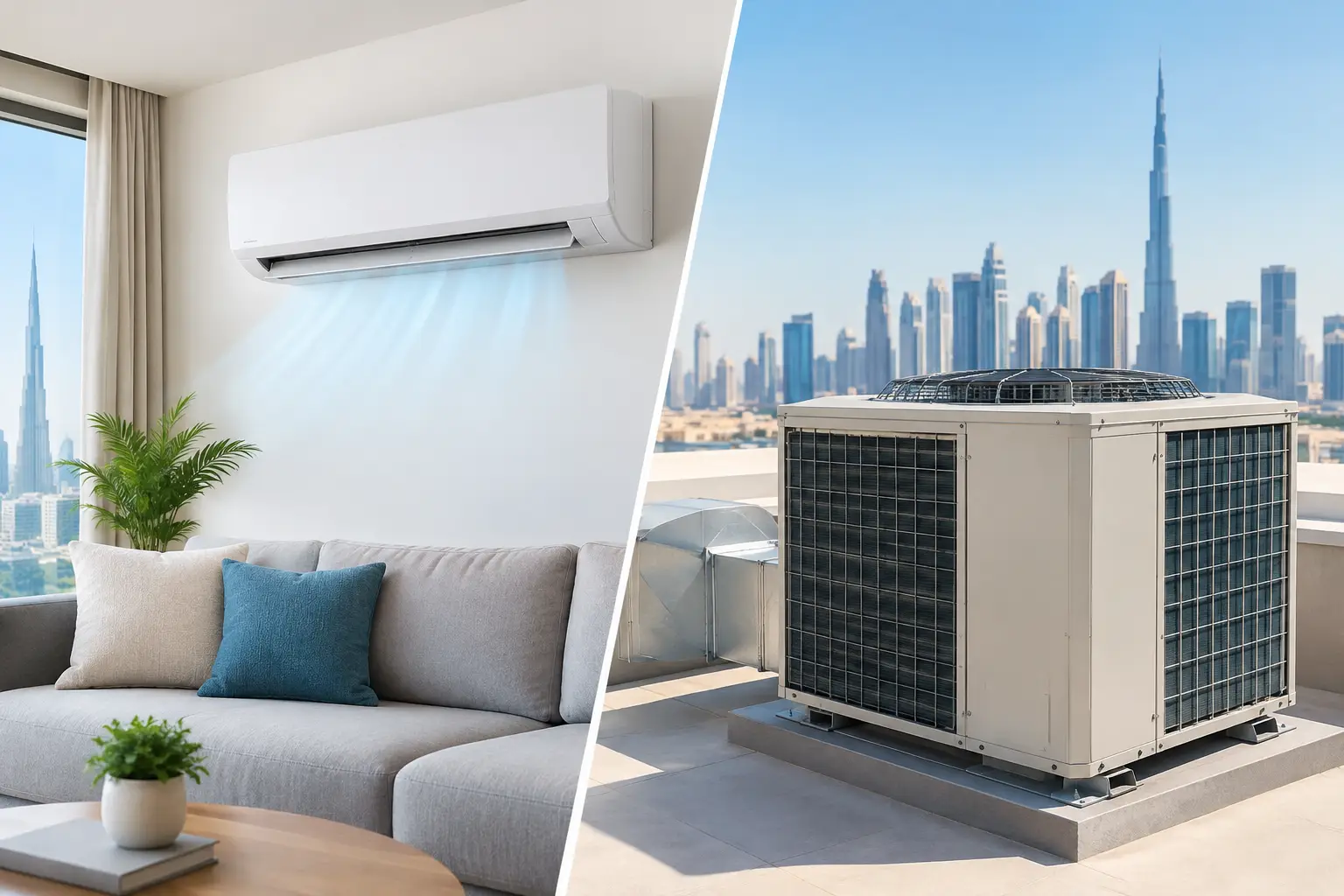
A cooling decision in Dubai is rarely just about buying an AC unit. The layout of the property, existing ductwork, building rules, outdoor-unit space, and how long you plan to stay all affect the answer. When comparing split AC versus central AC, the best option is the one that can be installed, maintained, and operated reliably in your specific property - not simply the system with the lowest upfront price.
For a studio or apartment, a well-sized split system may be practical and efficient. For a large villa with several bedrooms and open living areas, central air conditioning may provide better whole-home comfort and a cleaner finish. The details matter, especially through Dubai's long cooling season.
Split AC versus central AC: the main difference
A split AC system cools one room or one defined area. It has an indoor wall-mounted unit and an outdoor condenser connected by refrigerant pipes, electrical wiring, and a condensate drain. Multi-split systems can connect several indoor units to one outdoor unit, although each zone still has its own indoor unit and controls.
Central AC distributes conditioned air through ductwork. Depending on the property, this may be a ducted DX system with outdoor condensers, a concealed ducted split system, a package unit, or a building-provided chilled-water or district cooling arrangement. Air is delivered through ceiling diffusers and returned through grilles, so the equipment is less visible inside the rooms.
This distinction is especially relevant in Dubai apartments. A tenant may call the system central AC when the building supplies chilled water and the apartment has fan coil units. In that case, the resident does not choose or replace the main cooling plant. Their responsibility may be limited to thermostat settings, air filters, fan coil maintenance, drain cleaning, and reporting cooling issues to building management.
When split AC is the practical choice
Split AC is often the simpler option for a room addition, converted garage, small office, staff accommodation, or property where ductwork does not already exist. Installation is generally less disruptive because there is no need to open ceilings or construct a full duct network.
It also gives direct room-by-room control. You can cool an occupied bedroom at night without cooling unused rooms, which can reduce unnecessary runtime. For landlords, a split unit can be a useful targeted solution where one room consistently receives more sun or does not cool properly from the existing system.
However, the visible indoor units are not suitable for every interior. Each unit also needs proper drainage, a correctly sized refrigerant line set, safe electrical isolation, and access for servicing. A poor installation can lead to water leakage, weak cooling, vibration, noisy operation, and repeated refrigerant loss.
Split systems need regular cleaning in Dubai. Fine dust can block filters and coat the indoor coil, while high humidity can encourage drain-line blockage and odor around the indoor unit. Cleaning only the filter is helpful, but it does not replace inspection of the coil, blower wheel, drain tray, drain pipe, electrical terminals, and outdoor condenser.
Where central AC has the advantage
Central AC is usually the stronger long-term choice for larger villas, townhouses, and offices designed around ducted cooling. It provides a more integrated appearance, more even air distribution, and the ability to serve many rooms without wall-mounted units in every space.
A properly designed ducted system can also manage airflow more effectively in large open-plan areas. Supply air can be positioned away from seating areas, and return-air paths can be planned to prevent hot zones. This is harder to achieve with a single wall-mounted split AC trying to push air across a large living and dining space.
Central systems can be quieter in occupied rooms because the main fan and compressor equipment are concealed or located outside. But quiet operation depends on the quality of the installation. Undersized return grilles, loose duct connections, dirty filters, damaged insulation, or an incorrectly selected fan can create noticeable noise and reduce cooling performance.
The trade-off is that central AC involves more components. Ductwork, dampers, insulation, grilles, thermostats, condensate drains, air handlers, and outdoor equipment all need attention. A fault in one central system can also affect several rooms at once, while a split AC failure is usually limited to one zone.
Cost: look beyond the purchase price
Split AC usually costs less to add where no cooling system exists. The equipment and installation scope are smaller, and there is less finishing work afterward. It can be a sensible choice when only one or two rooms need cooling.
Central AC can cost more to install or replace because ductwork, ceiling access, duct insulation, electrical capacity, air distribution design, and controls may all require work. In an existing villa, replacing a central system can also uncover hidden issues such as deteriorated ducts, leaking joints, insufficient returns, or inaccessible drain lines.
Operating cost depends less on the system label and more on sizing, condition, controls, and usage. An oversized split unit may cool quickly but cycle inefficiently and remove less humidity. A poorly maintained central system may run for long periods because clogged filters or duct leakage reduce delivered airflow. Conversely, a correctly zoned central system or efficient inverter split AC can perform very well.
Before approving a replacement, ask for an assessment of the root cause. Weak cooling may be caused by a dirty coil, low airflow, thermostat fault, capacitor issue, refrigerant leak, duct leakage, blocked drain, or compressor problem. Replacing equipment without diagnosing the system can be an expensive mistake.
Comfort and air quality considerations
For comfort, central AC often produces a more consistent temperature across a full home. This is valuable in villas with multiple bedrooms, hallways, staircases, and large living spaces. If the system has appropriate zoning, different areas can be controlled separately rather than treating the entire property as one temperature zone.
Split AC provides excellent localized control. It works well when household members use rooms at different times or prefer different temperatures. It can also solve persistent heat in a top-floor room, glass-heavy office, or enclosed extension without modifying the entire central system.
Neither option automatically provides better indoor air quality. That comes down to maintenance and ventilation. Dirty filters, contaminated coils, neglected drain pans, and dusty ducts can affect either system. Central systems may need periodic duct inspection and cleaning when there is visible dust buildup, poor airflow, persistent odors, or contamination following renovation work. Duct cleaning should be based on condition, not sold as a substitute for resolving an active AC fault.
Installation limits in Dubai properties
Before choosing a system, check what the property allows. Apartment towers and managed communities may restrict where outdoor condensers can be installed, require contractor approvals, or prohibit changes to façades and common areas. Landlords should also confirm whether an alteration affects warranties, fit-out requirements, or tenant responsibilities.
In villas, outdoor-unit placement deserves careful planning. Condensers need adequate airflow and service access. Placing them in a tight, hot enclosure or directly beside bedrooms can cause poor performance and noise complaints. Drainage must also be routed safely to prevent water damage, staining, or slipping hazards.
For central AC, ceiling space and duct routing are decisive. A system cannot perform properly if ducts are squeezed into inadequate voids, sharply bent around obstacles, or left uninsulated in hot areas. Any installation proposal should explain the proposed equipment capacity, zones, thermostat locations, drainage route, electrical work, and the access needed for future maintenance.
Which system should you choose?
Choose split AC when you need targeted cooling, have limited installation access, want independent room control, or are adding cooling to a small space. It is also a practical answer when a single room has a specific comfort problem and the existing central system is otherwise functioning correctly.
Choose central AC when the property already has ducts in good condition, you need consistent cooling across a larger home or workplace, and you prefer concealed equipment. It is often the better fit for full-villa replacements, major renovations, and spaces where appearance and balanced airflow matter as much as room-level control.
If your current system is underperforming, start with a professional inspection rather than choosing based on assumptions. DHRS Dubai can assess cooling output, airflow, drainage, controls, coils, outdoor equipment, and duct condition, then explain whether repair, maintenance, targeted upgrades, or replacement makes practical sense.
The right AC system should be easy to service as well as comfortable to use. Select a solution that fits the property, receives regular preventive maintenance, and gives you clear control over the rooms that matter most.
Need Home Maintenance in Dubai?
Contact the experts at DHRS Dubai for fast, reliable service.
Get a Quote