
Which Filter Removes Hard Water Most Effectively?
White scale around a faucet, spots on shower glass, rough laundry, and a water heater that seems to lose efficiency are familiar property-maintenance issues. If you are asking which filter removes hard water, the direct answer is: an ion-exchange water softener is the system designed to remove the minerals that cause hardness. Most standard water filters are not.
That distinction matters before spending money on a countertop unit, under-sink cartridge, or whole-house filtration system that may improve taste but leave the root cause untouched. For homes and commercial properties in Dubai, the right solution depends on whether you want to protect plumbing and appliances, improve drinking water, or solve both problems separately.
Which Filter Removes Hard Water?
Hard water contains dissolved calcium and magnesium. These minerals are not usually visible in a glass of water, but they form scale when water is heated or evaporates. That scale can build up inside water heaters, shower mixers, washing machines, dishwashers, kettle elements, and pipework.
An ion-exchange water softener removes calcium and magnesium by passing water through resin beads charged with sodium or potassium ions. The hardness minerals attach to the resin, while sodium or potassium is released into the water in very small quantities. This process genuinely softens the water and prevents the minerals from continuing through the plumbing system.
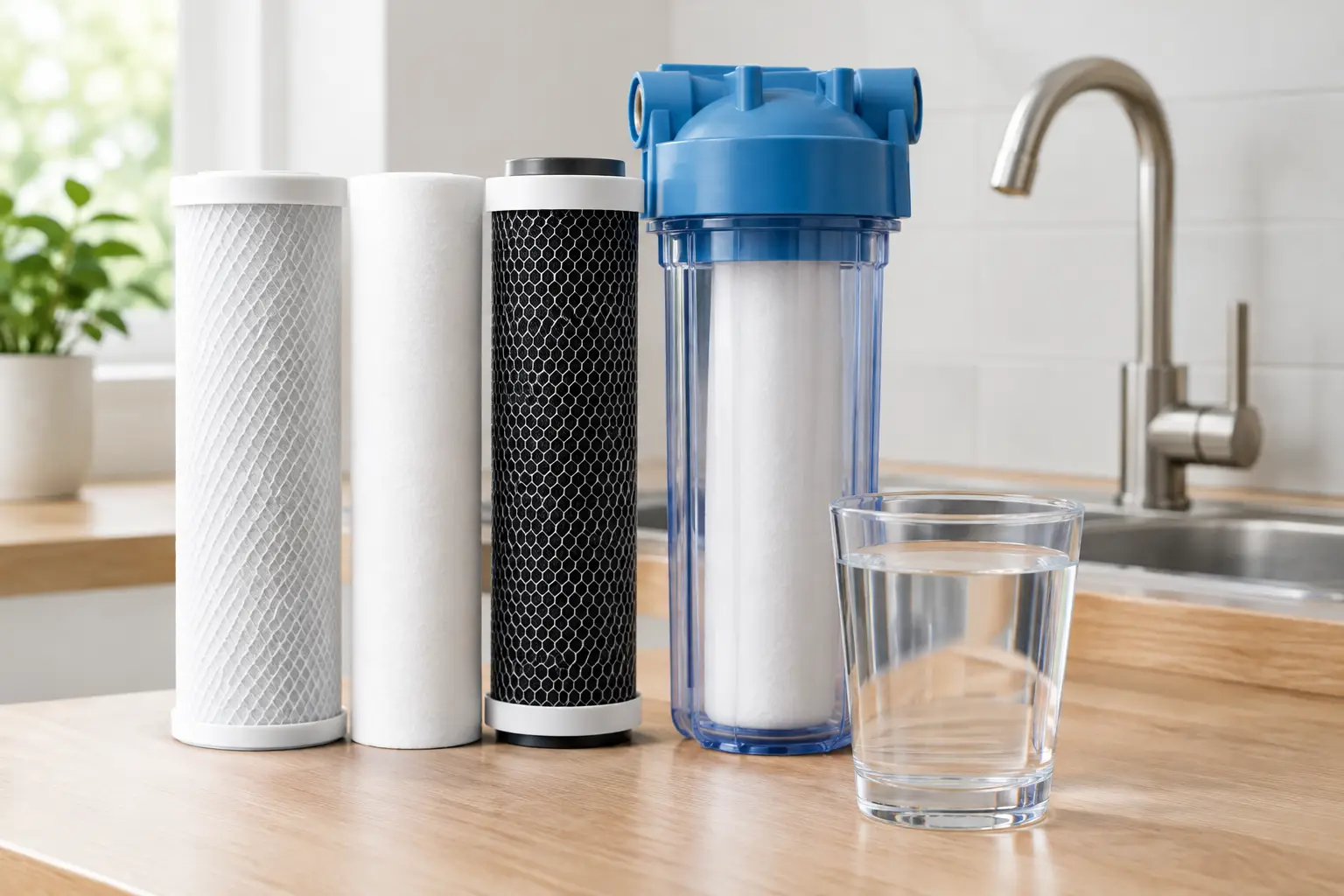
The term “filter” is often used broadly, but a sediment filter, carbon filter, UV purifier, or standard drinking-water cartridge does not remove hardness in the same way. Each has a useful role, just not the same job.
Why Ordinary Filters Do Not Solve Scale Problems
A sediment filter captures physical particles such as sand, rust, and debris. It is often fitted as a pre-filter to protect more sensitive equipment, but dissolved calcium and magnesium pass straight through it.
Activated carbon improves taste and odor and can reduce chlorine and certain organic compounds. It can make water more pleasant for drinking, but it does not substantially reduce hardness minerals.
UV systems disinfect water by treating microorganisms. They are valuable where water quality requires microbial control, yet they have no effect on hardness, salts, sediment, or scale.
This is why a homeowner may install a premium filter and still see white marks on fixtures. The filter may be operating correctly, but it is addressing a different water-quality concern.
The Best System Depends on Where You Need Soft Water
Whole-house ion-exchange softener
For properties with recurring scale on bathroom fixtures or reduced efficiency from water-heating equipment, a whole-house softener is generally the most practical option. It is installed on the main incoming water line so softened water reaches showers, faucets, water heaters, laundry equipment, and other connected fixtures.
This approach is particularly useful in villas, larger townhouses, and properties with several bathrooms. It can reduce scale-related cleaning, help maintain water flow through shower heads and aerators, and limit mineral buildup inside appliances. It does require adequate installation space, a drain connection for regeneration, and regular salt replenishment.
Sizing is not a guesswork exercise. A system should be selected according to household occupancy, water consumption, peak flow demand, available plumbing space, and tested water hardness. An undersized unit may struggle during high-demand periods, while an oversized one adds unnecessary cost and can use more water and salt than needed.
Under-sink reverse osmosis system
Reverse osmosis, commonly called RO, can remove a wide range of dissolved substances, including hardness minerals. It is highly effective for improving drinking and cooking water at a single point of use, typically the kitchen sink.
However, an RO system is not usually the best answer for whole-home hard-water protection. It produces water slowly compared with the demand from showers and appliances, requires periodic filter and membrane replacement, and creates reject water during its purification cycle. It is best viewed as a drinking-water solution rather than a substitute for a properly sized whole-house softener.
For many Dubai households, the sensible arrangement is a whole-house softener for scale control and an under-sink RO unit for drinking water. These systems solve different problems and can work well together when installed and maintained correctly.
Salt-free scale-control systems
Some systems are marketed as salt-free water softeners. Most do not remove calcium or magnesium from the water. Instead, they aim to alter how minerals crystallize so they are less likely to adhere to surfaces.
These systems may be suitable where installing a conventional softener is impractical, such as a location without access to a drain or a property where low maintenance is the priority. Still, they are better described as scale conditioners than true water softeners. They may reduce hard scale in some conditions, but they will not provide the same soap performance or mineral removal as ion exchange.
The trade-off should be explained clearly before installation. If your main complaint is heavy scale inside a water heater or on fixtures, an ion-exchange softener is typically the more dependable choice. If you cannot accommodate regeneration plumbing or salt handling, a conditioner may be a reasonable compromise.
Start With the Actual Problem, Not the Product Name
Before choosing equipment, identify what you are trying to fix. Scale buildup, unpleasant taste, sediment, odors, and concerns about drinking water quality can require different treatment stages. One device does not always do every job.
A professional inspection should assess the incoming supply, current pipework, available installation location, drain access, water pressure, household demand, and existing filtration equipment. Water testing can confirm hardness and help determine whether other treatment is needed.
In apartment buildings, the main practical question is often where the system can be installed. Many apartments have limited space near the water meter or water heater, and building-management approval may be required before changing common or concealed plumbing. A compact under-sink RO system may be straightforward for drinking water, while whole-apartment softening may need a more detailed site assessment.
Villas usually offer more flexibility, but proper installation remains essential. A softener needs a suitable bypass arrangement so the home can still receive water during servicing, along with correctly routed drain and overflow lines. Poor drainage or incorrectly installed valves can create avoidable leaks and operational issues.
Maintenance Is Part of the System, Not an Extra
Ion-exchange softeners regenerate periodically. During regeneration, the system flushes accumulated calcium and magnesium from the resin using brine made from softener salt. The salt tank must be checked and refilled before it runs empty.
How often this is needed depends on water hardness, system capacity, and property usage. A villa with a large family will use more capacity than a one-bedroom apartment. A demand-initiated control valve is often more efficient than a basic timer because it regenerates based on actual water use rather than a fixed schedule.
Pre-filters also need routine replacement. If sediment reaches the softener valve or resin tank, it can affect performance and shorten component life. RO systems require scheduled changes to sediment and carbon filters, plus membrane replacement at the appropriate interval. Ignoring these service requirements can reduce water quality and make the system less effective.
Water heaters deserve attention as well. A softener can reduce future scale formation, but it does not automatically remove thick existing deposits inside a tank or heat exchanger. In properties with a history of hard-water buildup, water-heater inspection and maintenance may be needed alongside the new treatment system.
Questions to Ask Before Installing a Hard-Water System
Ask whether the proposed equipment is a true ion-exchange softener or simply a scale conditioner. Confirm what it removes, what it does not remove, and whether it is intended for the whole property or a single drinking-water point.
You should also ask about flow rate at peak use, regeneration frequency, salt consumption, drainage requirements, replacement parts, annual maintenance, and the expected cost of consumables. Clear answers prevent the common problem of installing a system that sounds right on paper but cannot keep up with multiple showers, kitchen use, and laundry demand.
For landlords and property managers, service access matters too. Equipment should be installed where filters can be changed, salt can be added, and technicians can inspect valves without dismantling cabinetry or interrupting tenants unnecessarily.
A Practical Choice for Dubai Properties
If your priority is stopping hard-water scale throughout the property, choose a correctly sized ion-exchange water softener. If you want highly treated water for drinking and cooking, add an under-sink RO system. If full softening is not possible due to drainage, space, or building constraints, discuss a scale-conditioning option with realistic expectations.
DHRS Dubai can inspect the installation conditions, explain the available options in plain language, and recommend equipment based on the property rather than a one-size-fits-all package. The right system should protect your plumbing and appliances while remaining practical to maintain long after installation day.
Need Home Maintenance in Dubai?
Contact the experts at DHRS Dubai for fast, reliable service.
Get a Quote