
Home Water Filtration Installation in Dubai
A glass of water may look clear while still carrying sediment, chlorine taste, or mineral content that affects its flavor and the condition of plumbing fixtures. Home water filtration installation gives Dubai residents a practical way to improve water quality at the point where it matters most, whether that is one kitchen tap, a refrigerator supply, or the whole property.
The right solution depends on the water concern, the property layout, available space, and how much water the household uses. A compact under-sink unit can be ideal for an apartment kitchen. A villa with several bathrooms, appliances, and water heaters may benefit more from filtration at the main incoming line. Choosing a system before checking these details is one of the most common reasons owners end up with poor flow, difficult maintenance, or equipment that does not address the actual issue.
Start With the Water Problem, Not the Filter
Water filtration is not one single treatment. Different filter media and system designs target different contaminants or conditions. Sediment filtration captures sand, rust particles, and debris that may enter through tanks, aging pipes, or supply lines. Carbon filtration is commonly used to reduce chlorine taste and odor. Reverse osmosis systems use a membrane to remove a wider range of dissolved solids, making them a common choice for drinking-water points.
Hard-water treatment is a separate consideration. In Dubai, mineral buildup can appear on shower glass, faucets, water heaters, and appliances. A water softener may help reduce scale, but it does not serve the same role as a drinking-water filter. Some properties need both: a whole-home scale-control or softening solution and a dedicated reverse osmosis system at the kitchen sink.
Before recommending equipment, a technician should ask practical questions. Is the concern drinking water taste, sediment in tap aerators, recurring scale, low water pressure, or a water tank that has not been cleaned on schedule? The root cause may be a combination of tank condition, pipework, pressure settings, and filtration needs.
Choosing a Home Water Filtration Installation Setup
For most homes, the decision comes down to point-of-use or whole-home filtration. Neither is automatically better.
Under-sink drinking-water filters
An under-sink system is installed inside the kitchen cabinet and usually supplies a separate drinking-water faucet or a compatible existing faucet. It is a focused option for tenants, apartment residents, and households that mainly want filtered water for drinking and cooking.
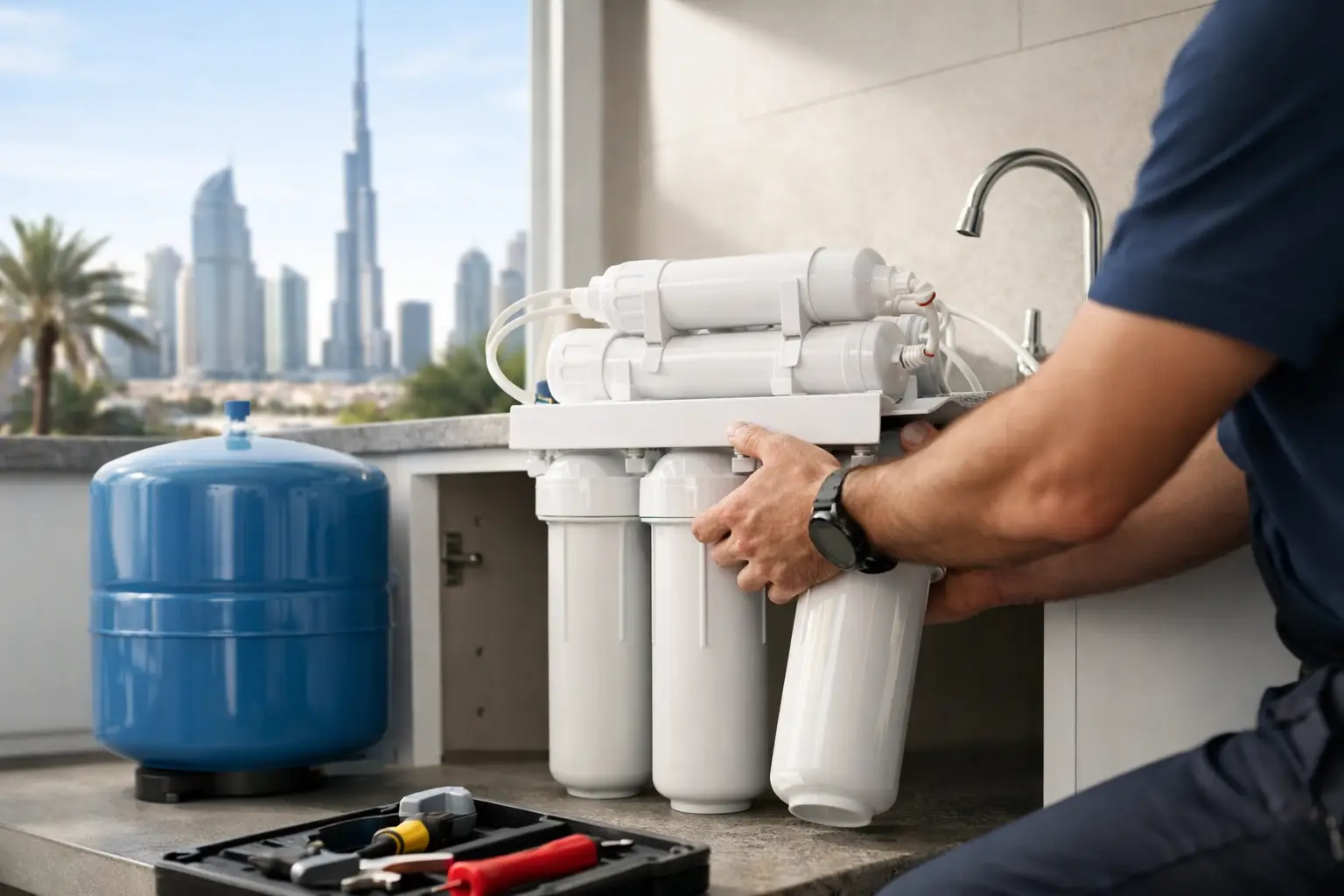
Carbon filters are generally compact and require less space. Reverse osmosis systems require more room because they include multiple filter stages, a membrane, tubing, and often a storage tank. They also produce wastewater during the filtration process, so the drain connection must be installed correctly.
An under-sink system will not protect showers, washing machines, water heaters, or bathroom fixtures from sediment or scale. That trade-off is acceptable when drinking water is the only priority.
Main-line and whole-home filters
A main-line filter is fitted near the property’s incoming water supply, often in a utility area, service shaft, pump room, or external cabinet. It treats water before it travels to taps, appliances, and bathrooms.
This approach is particularly useful in villas and larger townhouses where sediment can affect multiple fixtures. It can also help protect valves, mixer cartridges, water heaters, and washing machines. However, whole-home systems need enough installation space, accessible isolation valves, suitable drainage where required, and a design that does not restrict flow to the property.
For a larger property, the filter housing and pipe size matter. Installing a small domestic filter on a high-demand villa line can create pressure complaints when several showers or appliances operate at once. A professional assessment should account for the number of bathrooms, occupants, pump arrangement, and peak water demand.
What a Professional Installation Should Include
A proper installation is more than attaching a filter housing to a pipe. The work should begin by identifying the water source, existing valve locations, pipe material, pressure conditions, and a practical service position for future cartridge replacement.
The water supply must be isolated safely before any pipe is cut or opened. A technician then installs the required fittings, bypass arrangement where appropriate, filter housings, and pressure gauges if included in the system design. On a reverse osmosis installation, the drain line, storage tank, faucet connection, and feed valve also need careful routing to prevent leaks and cabinet damage.
After the system is fitted, the filters should be flushed according to the manufacturer’s requirements. New carbon cartridges can release fine particles during the first flush, while reverse osmosis membranes require initial conditioning. The technician should then check every connection under pressure, inspect for leaks, confirm the water direction through the unit, and verify that flow remains suitable for normal use.
Clear handover matters as much as the plumbing work. Residents should know where the isolation valve is, which cartridges are installed, when they are likely to need replacement, and what changes in taste, flow, or water appearance should prompt a service call.
Dubai-Specific Installation Considerations
Dubai properties often have roof or ground-level water storage tanks, booster pumps, and different plumbing arrangements between towers, villas, and gated communities. This means a filter that works well in one home may need a different setup in another.
For example, tank sediment can shorten the life of fine filter cartridges. If a property has visible debris in water, recurring clogged aerators, or an overdue tank-cleaning schedule, fitting an expensive drinking-water system without addressing the tank condition can lead to unnecessary replacement costs. Water tank cleaning and a sediment pre-filter may be the sensible first steps.
High temperatures also matter where filters are installed outdoors or in poorly ventilated service areas. Filter housings, tubing, and cartridges should be appropriate for the location and protected from direct sun where possible. Equipment must remain accessible without forcing a technician to dismantle cabinetry, ceiling panels, or pipe enclosures at every service visit.
Tenants should also check building and landlord requirements before altering main supply pipes. In many apartments, an under-sink drinking-water filter is simpler to approve and easier to remove at the end of a tenancy than a main-line modification.
Maintenance Is Part of the System Design
A filtration system only performs properly when its cartridges and components are maintained on time. The exact schedule depends on water quality, usage, filter capacity, and the type of system. A family that cooks frequently and fills bottles daily will use a kitchen filter faster than a single occupant.
Sediment cartridges often need attention first because they collect visible particles. If left too long, they can reduce pressure and place additional load on later filter stages. Carbon cartridges have a limited absorption capacity, so water may begin to taste or smell different when replacement is due. Reverse osmosis membranes usually last longer than pre-filters, but their life is affected by incoming water quality and maintenance discipline.
Do not wait for a complete loss of flow before arranging service. Warning signs include a noticeable pressure drop, unusual taste or odor, leaking beneath the sink, cloudy initial water that does not clear after normal use, or frequent appliance scale despite a treatment system. These signs do not always mean the filter itself has failed, but they justify an inspection.
Common Mistakes to Avoid
The first mistake is buying filtration equipment based only on online specifications. A system may be capable on paper but unsuitable for the available pressure, cabinet space, pipe size, or expected demand.
The second is installing a filter where it cannot be serviced. A cartridge housing hidden behind fixed panels or above a ceiling may turn a simple replacement into a disruptive plumbing job. Leave enough clearance below filter housings for removal and protect nearby cabinets from possible drips.
The third is treating filtration as a substitute for property maintenance. Filters can reduce sediment reaching fixtures, but they do not repair corroded pipes, solve a poorly maintained tank, or correct a pressure problem. Honest diagnostics should separate these issues so replacements are recommended only when genuinely required.
When to Book Professional Help
Professional support is especially worthwhile when installing a main-line unit, reverse osmosis system, water softener, or any setup that requires pipe cutting, drainage connections, pressure adjustments, or pump coordination. It is also the safer choice when there is existing leakage, restricted water pressure, complex cabinetry, or uncertainty about the source of water quality concerns.
DHRS Dubai can inspect the installation location, explain suitable options in clear terms, and complete the plumbing work with proper testing before handover. For property owners and managers, scheduling filtration service alongside water tank cleaning or preventive plumbing maintenance can reduce repeat visits and help keep the system performing as intended.
Better water starts with a system matched to the property, not the most complicated unit on the shelf. A well-planned installation, accessible maintenance, and timely cartridge changes will deliver more reliable results than an oversized filter that no one can service properly.
Need Home Maintenance in Dubai?
Contact the experts at DHRS Dubai for fast, reliable service.
Get a Quote